
Mexico faces one of the greatest opportunities industrial in its history. The relocation of supply chains, the growth of the manufacturing sector, the demand for strategic minerals for the energy transition, and the accelerated expansion of data centers require increasingly larger amounts of reliable energy. However, this growth also implies a fundamental challenge: reducing greenhouse gas emissions without compromising industrial competitiveness.
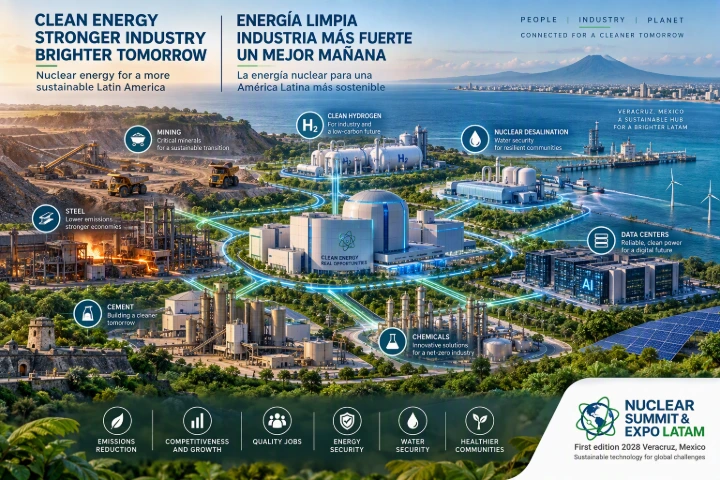
Sectors such as mining, steelmaking, cement, and the chemical industry constitute the backbone of national economic development. At the same time, they rank among the productive activities with the highest carbon emissions worldwide. According to the International Energy Agency (IEA), the industry accounts for approximately 25% of global CO₂ emissions related to energy, with the steel, cement, and chemical sectors being some of the largest contributors.
The transition to clean industrial processes is not only an environmental obligation; it represents an economic, technological, and strategic necessity to ensure Mexico's competitiveness in the coming decades.
In this context, nuclear energy emerges as one of the few technologies capable of providing clean energy 24 hours a day, in addition to providing industrial heat, producing clean hydrogen, supporting desalination processes, and meeting the growing energy demand of data centers and artificial intelligence systems.
The urgency of decarbonizing heavy industry
Industrial transformation is one of the fundamental pillars for achieving global climate goals. Heavy industry continues to rely heavily on fossil fuels to generate process heat, electricity, and energy raw materials.
The figures are compelling:
- The industry generates approximately a quarter of global energy-related CO₂ emissions..
- Cement production is responsible for around 7-8% of global CO₂ emissions..
- The steel industry contributes approximately 7% of global greenhouse gas emissions..
- The chemical industry consumes enormous amounts of electricity, steam, and hydrogen for its production processes.
Particularly:
Cement
Cement production faces a dual environmental challenge. In addition to energy consumption, the chemical reaction needed to produce clinker generates CO₂ emissions inherent to the process. This makes cement one of the most difficult industrial sectors to decarbonize.
Steel
Conventional steel production relies on metallurgical coal and coke to reduce iron ore. Replacing these inputs requires new sources of clean energy and low- emission hydrogen.
Chemical industry
The chemical industry is responsible for a significant part of global industrial energy consumption. The production of fertilizers, ammonia, synthetic fuels, and petrochemical products requires large amounts of electricity and heat.
Mining
The extraction and processing of critical minerals for batteries, electrification, and clean technologies requires enormous amounts of energy. As global demand for lithium, copper, and rare earths increases, so does the need for clean energy to process them sustainably.
To meet international climate goals and maintain access to increasingly demanding markets regarding carbon footprint, these sectors will need to drastically reduce their emissions over the coming decades.
Nuclear energy: much more than electricity
Nuclear energy is often associated solely with electricity production. However, advanced reactors and Small Modular Reactors (SMRs) are designed to provide multiple energy services simultaneously.
The International Atomic Energy Agency (IAEA) identifies non-electric applications that include:
- Base load electricity.
- High-temperature industrial heat.
- Cogeneration.
- Production of clean hydrogen.
- Desalination of water.
- Industrial heating and cooling.
- Steam production for industrial processes.
This versatility makes nuclear energy a comprehensive energy platform capable of meeting multiple industrial needs with a single energy infrastructure.
Clean base load for the Mexican industry
One of the main advantages of nuclear energy is its ability to operate continuously.
Unlike variable sources, nuclear reactors can provide stable energy 24 hours a day throughout the year, achieving capacity factors above 90%.
This feature is especially important for:
- Steel complexes.
- Chemical plants.
- Mining operations.
- Refineries.
- Data centers.
- Desalination plants.
Additionally, nuclear energy has one of the lowest carbon footprints among all available technologies.
Comparison of lifecycle emissions
|
Technology |
Emissions (gCO₂e/kWh) |
|
Nuclear |
~12 |
|
Wind |
~11 |
|
Solar photovoltaic |
~45 |
|
Natural gas |
~490 |
|
Coal |
~820 |
These values demonstrate that nuclear energy provides climate benefits comparable to renewable energies and significantly better than fossil fuels.
Nuclear hydrogen: a key piece for the industry of the future
Hydrogen is set to play an essential role in the decarbonization of hard-to-electrify industries.
Currently, global hydrogen production generates approximately 900 million tons of CO₂ per year, due to the predominant use of natural gas and coal.
Advanced nuclear reactors can produce carbon-free hydrogen using high-temperature electricity and heat through advanced electrolysis processes.
Applications include:
- Low-carbon steel production.
- Manufacturing of fertilizers.
- Production of clean ammonia.
- Sustainable synthetic fuels.
- Low-emission oil refining.
- Energy storage.
For Mexico, nuclear hydrogen represents an opportunity to increase the competitiveness of industrial exports in markets subject to increasingly strict climate regulations.
Nuclear desalination to address water stress
Water is a critical factor for industrial development.
According to the United Nations, more than 2 billion people live in regions with severe water stress, and this situation continues to worsen due to population growth and climate change.
In Mexico, industrial regions such as:
- Sonora
- Chihuahua
- Coahuila
- Baja California
- Nuevo León
face increasing challenges related to access to water.
The combination of nuclear energy and desalination offers a sustainable solution that can provide simultaneously:
- Clean electricity.
- Drinking water.
- Water for industrial processes.
- Water security for communities.
Nuclear desalination could become a strategic tool to support new industrial corridors in arid regions of the country.
Data centers and artificial intelligence: a new energy frontier
The digital revolution is causing an unprecedented transformation in electricity demand.
Currently, data centers represent between 1% and 2% of global electricity consumption, while the demand associated with artificial intelligence could double before 2030.
Large tech companies are already exploring agreements to use advanced reactors and SMRs as a source of reliable, emission-free electricity.
The advantages for data centers include:
- Energy available 24/7.
- Low carbon footprint.
- High reliability.
- Less exposure to fossil fuel volatility.
- Modular expansion capability.
For Mexico, this represents an opportunity to consolidate as a regional center for:
- Artificial intelligence.
- Cloud computing.
- Advanced manufacturing.
- Digital services.
- Technological innovation.
A catalyst for mining, steel, cement, and chemicals
Advanced reactors and SMRs could be strategically installed near industrial complexes to supply electricity, vapor, and process heat.
Mining industry
- Electrification of machinery.
- Local hydrogen production.
- Clean processing of strategic minerals.
- Reduction of diesel consumption.
Steel industry
- Hydrogen production for direct iron reduction.
- Less dependence on metallurgical coal.
- Steel with a lower carbon footprint.
Cement industry
- Clean energy for productive processes.
- Future integration with carbon capture.
- Significant reduction of indirect emissions.
Chemical industry
- Clean ammonia production.
- Manufacturing of sustainable fertilizers.
- Continuous generation of industrial steam.
- Low-emission hydrogen production.
An opportunity for Mexico and Latin America
The energy transition should not be understood as competition between technologies but as an integration of complementary solutions.
Nuclear energy can coexist and enhance other clean technologies such as:
- Solar energy.
- Wind energy.
- Storage systems.
- Smart grids.
- Clean hydrogen.
Mexico has important strengths:
- Nuclear operational experience.
- Consolidated regulatory infrastructure.
- Highly specialized human capital.
- Robust manufacturing industry.
- Strategic position for nearshoring.
The deployment of advanced nuclear technologies could attract new investments, strengthen regional supply chains, and generate high-specialization jobs, simultaneously contributing to economic growth and climate change mitigation.
Conclusion
The decarbonization of heavy industry represents one of the greatest technological and economic challenges of the 21st century. Mining, steelmaking, the cement industry, chemicals, and new data centers will require massive amounts of clean, reliable, and affordable energy to maintain their competitiveness.
Nuclear energy offers a comprehensive solution that goes far beyond electricity generation. Its ability to provide baseload power, industrial heat, cogeneration, clean hydrogen, and desalination makes it a strategic tool for building sustainable industrial systems.
For Mexico, nuclear energy should not be seen only as an additional source of electricity, but as a technological platform capable of driving the industrial transformation of the country. By integrating with renewable energies, digital infrastructure, and new industrial value chains, it can help create a cleaner, more resilient, and competitive economy.
The question is no longer whether we should decarbonize the industry. The real question is how to do so while maintaining economic growth, energy security, and social prosperity. In that answer, nuclear energy has the potential to play a fundamental role.
Main references
- International Energy Agency (IEA). Net Zero Roadmap: A Global Pathway to Keep the 1.5°C Goal in Reach. Paris: IEA, 2023.
- International Energy Agency (IEA). Energy Technology Perspectives 2024. Paris: International Energy Agency, 2024.
- International Atomic Energy Agency (IAEA). Advances in Small Modular Reactor Technology Developments. Vienna: IAEA, latest edition.
- International Atomic Energy Agency (IAEA). Industrial Applications of Nuclear Energy. Vienna: IAEA.
- International Atomic Energy Agency (IAEA). Nuclear Desalination: Opportunities and Challenges. Vienna: IAEA.
- Intergovernmental Panel on Climate Change (IPCC). Climate Change 2022: Mitigation of Climate Change. Working Group III Contribution to the Sixth Assessment Report. Geneva: IPCC, 2022.
- Organisation for Economic Co-operation and Development (OECD) Nuclear Energy Agency (NEA). Nuclear Energy for a Net Zero World. Paris: OECD-NEA, 2023.
- World Nuclear Association (WNA). The Harmony Programme: Nuclear Energy in a Sustainable Energy Future. London: WNA.
- United Nations Industrial Development Organization (UNIDO). Industrial Development Report. Vienna: UNIDO.
- International Energy Agency (IEA). Electricity 2024: Analysis and Forecast to 2026. Paris: IEA, 2024.